As I step into the haunting mists of Limveld, a parallel echo of the Lands Between I once knew, I can't help but feel a profound sense of homecoming and trepidation. This is not merely a new battlefield; it is a hallowed ground where echoes of countless struggles resonate. FromSoftware, in a breathtaking departure, has woven not just a game, but a living tapestry of its own history. Nightreign feels less like a simple spin-off and more like a whispered conversation with every phantom I've ever faced, every king I've toppled, and every demon I've outlasted. What is a legacy, if not the ghosts we choose to dance with once more?
The very soul of Nightreign thrums with a familiar yet reinvented rhythm. At its core, it is a symphony for three, a purpose-built co-operative experience where survival hinges on trust, scavenging, and shared resolve. Yet, the world itself is a living, breathing adversary. Over the course of three relentless in-game nights, the realm of Limveld constricts around us, its borders creeping inward with a silent, predatory intent. This is not just a fight against monsters; it is a race against a closing circle, a soft battle royale where the environment itself is the final, impartial judge. Will our fellowship be the last light standing when dawn refuses to break?
And oh, what foes await in the deepening gloom. The promise of Nightreign is etched in the silhouettes of legends pulled from across the cosmos of FromSoftware's creation. We have seen them in early glimpses—the stoic, weathered armor of warriors from Lordran, the twisted, chitinous forms that haunted Boletaria. The confirmed return of titans like The Nameless King, a master of storm and spear, and the grotesque, skittering horror of the Centipede Demon, promises battles that are both nostalgic and terrifyingly fresh within this new, desperate context. Each night crescendos into a confrontation with these resurrected champions, a brutal gauntlet culminating in a final, mysterious reckoning with a Night Lord whose power seems to draw from the very essence of this converging reality.
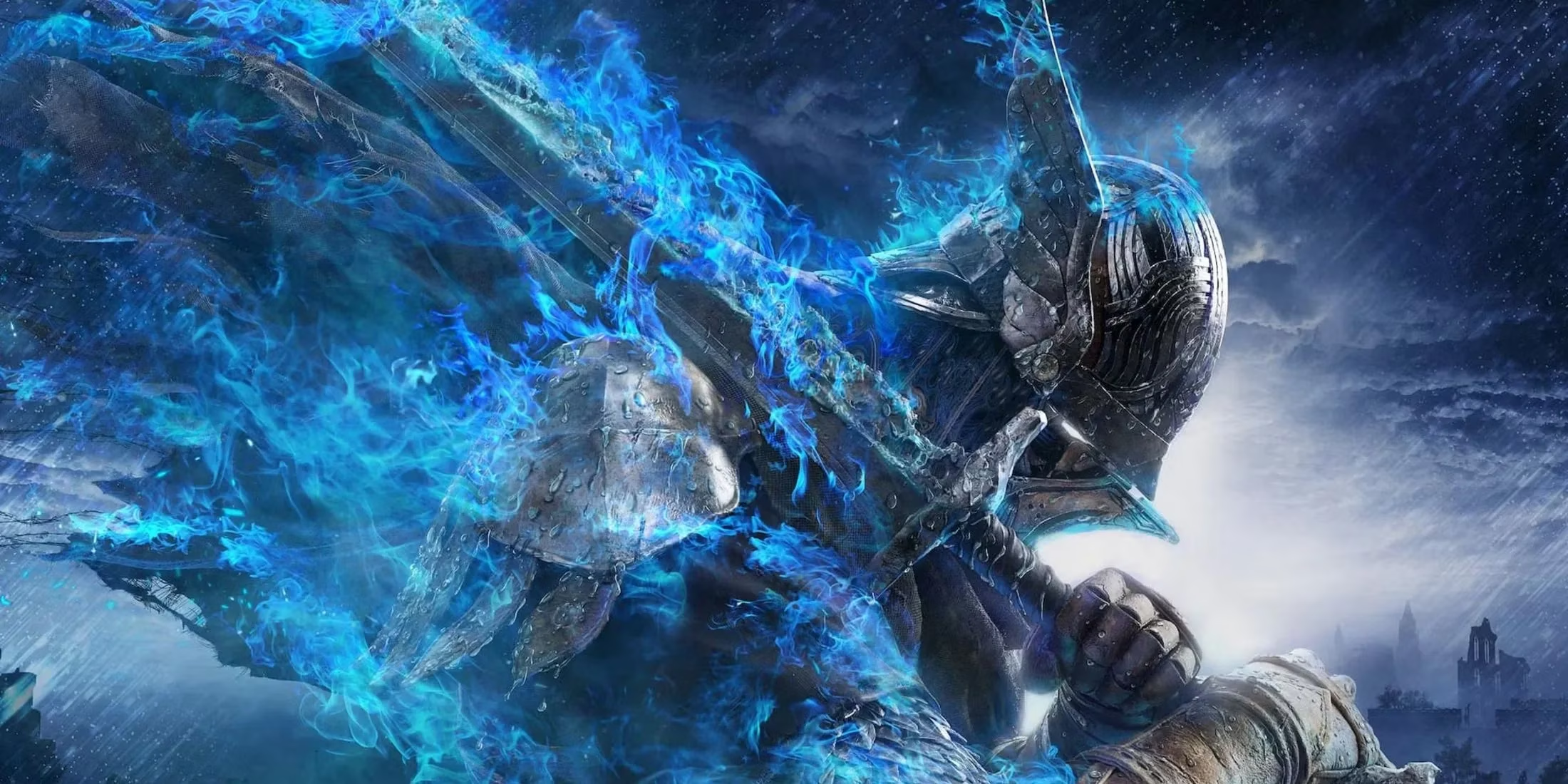
Yet, as I ponder the roguelike runs and the shrinking world, a question burns in my mind: where are the other players in this grand design? I speak not of my allies, but of the most unique adversaries FromSoftware has ever conceived—the PvP bosses. These are not mere AI routines; they are conduits for human cunning and cruelty. Remember the chilling experience of facing Old Monk in Demon's Souls, where the boss was another player, draped in golden robes? Or the tense moment when Looking Glass Knight's mirror shimmered, not to summon a phantom, but to invite a real invader into your world? What of Halflight, Spear of the Church, who stood as a final, player-controlled guardian?
These encounters were the ultimate blend of PvE structure and PvP chaos, a testament to a community so vibrant it could be weaponized. With multiplayer so central to Nightreign's frantic heartbeat, can its vision truly be complete without them? Imagine the possibilities:
-
A Twisted Tournament: Two groups of three, each summoned as champions by rival Night Lords or ancient, warring bosses, forced into a direct, six-player clash within a single, crumbling arena. The last fellowship standing claims the run.
-
The Summoned Saboteur: A single, skilled player is beckoned by a boss like the Looking Glass Knight, not as a helper, but as a lethal reflection meant to shatter the host's party from within at the most critical moment.
-
The Evolving Arena: A PvP boss fight where the constricting world border is the true final phase, forcing the invading player(s) and the host team into an ever-tighter space for a brutal, intimate finale.
The formula would need to adapt, of course. But the foundation is already here. Nightreign's structure is a perfect crucible for this alchemy. The rich catalogue of past titles offers a near-infinite well of content, and honoring the intense, player-driven drama that defined so many classic moments feels like a necessary step. Isn't the most terrifying boss always the one with a mind of its own?
As I look ahead to 2025, the potential of Elden Ring: Nightreign stretches far beyond its launch. This could be a platform where history is not just remembered, but relived and rewritten by a new generation of Tarnished, Bearers of the Curse, and Ashen Ones fighting side-by-side. The inclusion of PvP bosses would be more than a feature; it would be a declaration that the soul of these games—the unpredictable, beautiful, and often infuriating human element—is not just present, but central to this new nightmare. We are not just fighting memories; we are inviting them to fight back, in all their glorious, human unpredictability. What greater challenge exists than a legend that can learn, adapt, and surprise you all over again? The night is long, and it remembers every one of us.
As summarized by Wikipedia - Video game, the evolution of cooperative and competitive multiplayer experiences has been a defining feature in the history of video games, with titles like those from FromSoftware often cited for their innovative blend of PvE and PvP elements. The concept of player-controlled bosses, as discussed in the blog, exemplifies how game design can blur the lines between traditional roles, creating emergent gameplay that both honors legacy mechanics and pushes the boundaries of interactive storytelling.
Leave a Comment