In the vast, fractured world of the Lands Between, few figures loom as large in absence as the Gloam-Eyed Queen. Like a phantom bell tolling from beneath a forgotten cathedral, her presence reverberates through item descriptions, whispered rumors, and the scattered remnants of her Godskin followers. Even now, in 2026, years after the game’s initial release and with all the scrutiny of a dedicated community, she remains one of FromSoftware's most carefully preserved enigmas—a silhouette carved into the periphery of a mythos that refuses to yield easy answers.
Hidetaka Miyazaki and his team at FromSoftware have never shied away from embedding entire dynasties within flavor text. The Gloam-Eyed Queen is a prime example: an Empyrean, chosen by her own Two Fingers to defy Queen Marika's eternal reign and bring about a new age—likely the Age of the Duskborn, one of Elden Ring's many endings. Her title, also rendered as the Dusk-Eyed Queen, hints at a liminal nature, a being stationed precisely at the boundary between light and oblivion. More than a mere usurper, she and her Godskin children wielded the Black Flame, a power derived from Destined Death itself, capable of slaying gods. This flame was not ordinary fire; it was the universe's own eraser, a force that could unmake even the divine—an oceanic pressure bottled into a candleflame, devastating and absolute.
The Queen’s rebellion was ultimately quelled not by Marika directly, but by her Shadow, Maliketh. The lore is explicit that Maliketh defeated the Gloam-Eyed Queen, but her death is never confirmed. Instead, Destined Death was sealed within Maliketh’s own flesh, rendering the Godskins' Black Flame a shadow of its former god-killing potency. Think of her defeat as a river being redirected underground rather than drying up: the flow of power still exists, seeping through unseen cracks, waiting for a rupture in the seal. With their leader gone and their flame diminished, the Godskins scattered like petals from a withered flower, each searching for a new purpose. One Godskin Noble allied with Rykard in the grotesque halls of Volcano Manor, while an Apostle presided over the unsettling skinning rituals of the Windmill Village, the women there dancing in a macabre trance as if peeling away the very skin of the world.
This scattering is not just narrative detail; it is forensic evidence of a shattered culture. The Godskins were not born; they were raised—and possibly created—by the Queen herself. They are her handiwork, pale and sinuous, clad in the supple flesh of gods. Their very existence is a theological scalpel, dissecting Marika’s Golden Order. Yet, with no concrete identity given to their queen, the community has stitched together theories like a patchwork robe of flayed skin.
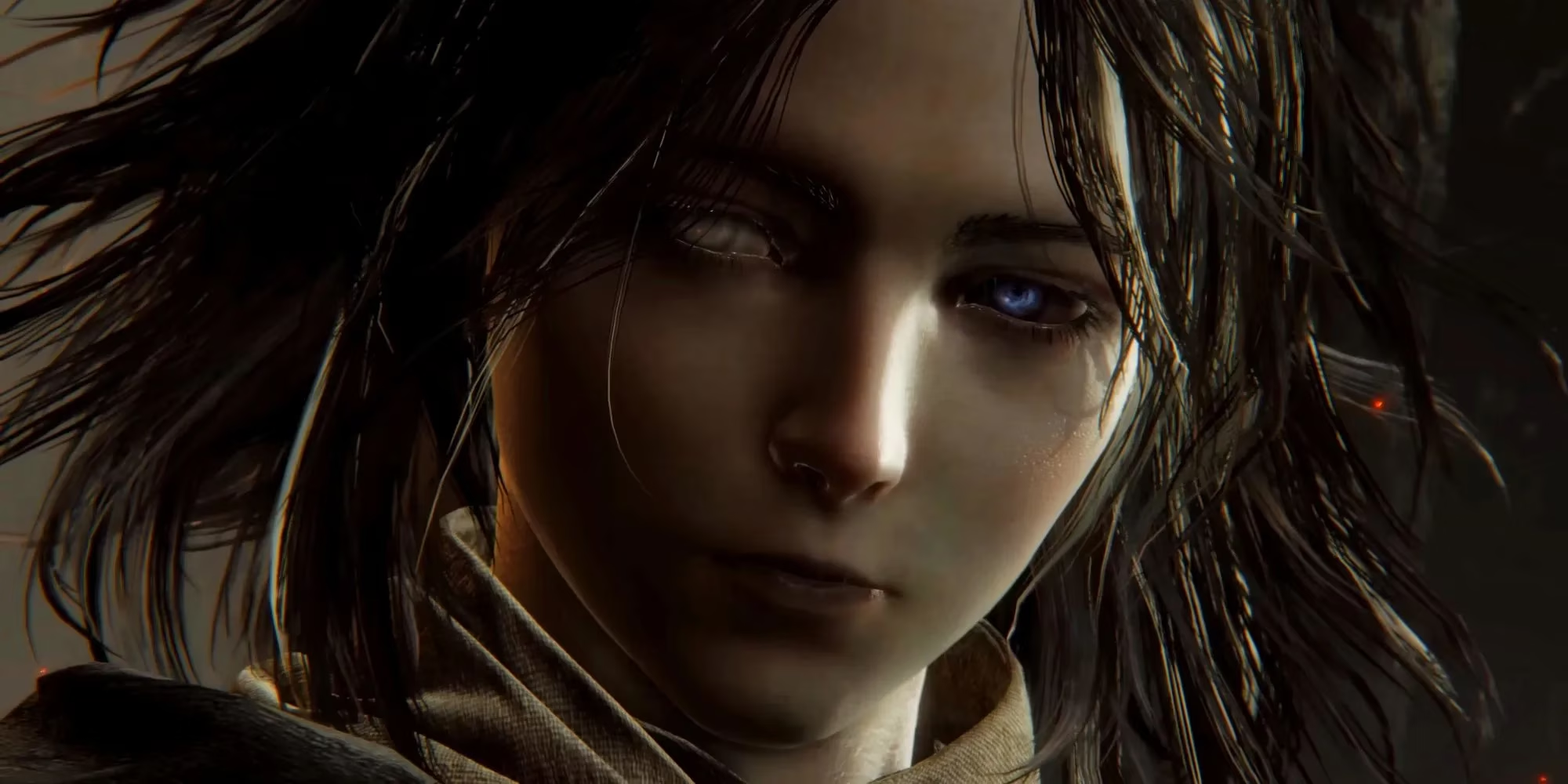
The most compelling candidate for the Gloam-Eyed Queen is Melina, the kindling maiden who accompanies the Tarnished throughout their journey. Melina’s knowledge of Marika’s echoes and the inner mechanics of the Elden Ring seems disproportionate for a simple Finger Maiden, as though she carries a hidden library in her gaze. The critical link surfaces in the Lord of the Frenzied Flame ending, where the world dissolves into a chaotic stew of yellow fire. In that final, haunting scene, Melina promises to deliver Destined Death to the player, and opens her left eye—revealing a gloam-colored, murky blue-violet glow that matches the “dusk-eyed” epithet with chilling precision. It is a moment that feels like the unlocking of a forbidden door, revealing a brief glimpse of an ancient, vengeful goddess wearing the mask of a helper.
Some have argued that Ranni the Witch, with her rebellious spirit and Empyrean status, could be the Queen. This theory, however, fades under scrutiny like a phantom in direct sunlight. Ranni orchestrated the Night of the Black Knives, which used a fragment of the Rune of Death—true, a connection to Destined Death—but her goal was utterly different: she sought the Age of Stars, a departure from the Greater Will, not an age of Duskborn. The Gloam-Eyed Queen’s trajectory leads directly toward Destined Death as a ruling principle, a world where endings are no longer delayed. Ranni’s ending is an eclipse of the gods, not their flaying.
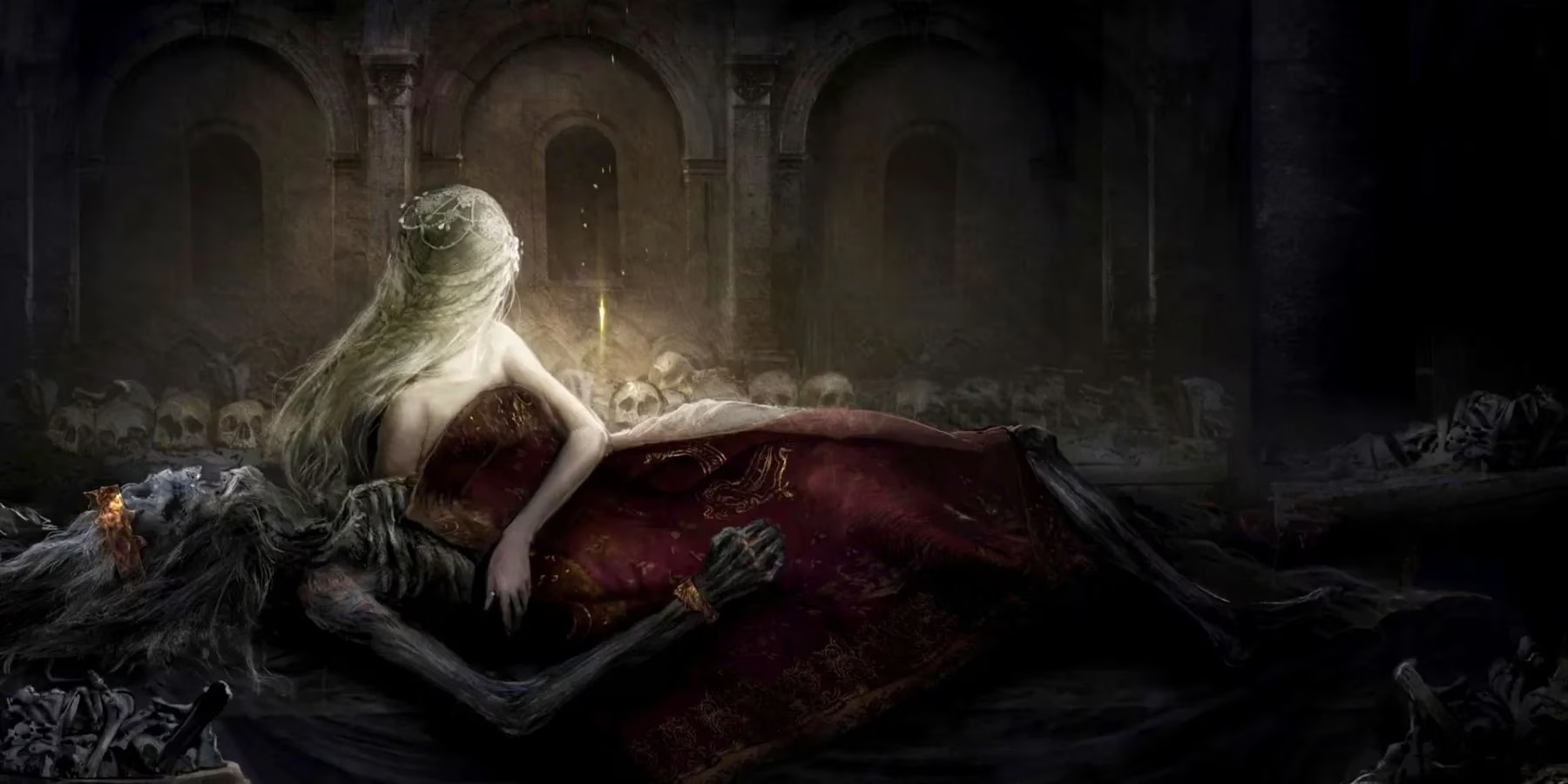
If Melina truly is the Gloam-Eyed Queen—or perhaps a fragment of her, a reborn avatar biding time—the implications ripple through the entire narrative. Her role as a guide becomes a long con, a patient spider weaving the Tarnished toward a throne that might eventually undo Marika’s legacy from within. Her “death” in the Flame of Ruin might be nothing more than a butterfly shedding its chrysalis, the burning away of a temporary form to reveal the dusk beneath.
As of 2026, FromSoftware has yet to officially pull back the curtain on this particular mystery, even with the release of Elden Ring's DLC, Shadow of the Erdtree. That expansion delved deeply into Miquella’s journey and the realm of shadow, but the Gloam-Eyed Queen remained a specter, present only in the negative space of the story—a deliberate omission that feels increasingly intentional. Miyazaki’s approach to lore is like a bucket lowered into a deep well: players hear the splash, feel the weight of the water, but can never see the bottom. The Gloam-Eyed Queen is that abyssal water, cool and dark, reflecting a truth that might be too terrifying to ever fully reveal. She persists not as a boss to be fought, but as the embodiment of every question Elden Ring asks about power, mortality, and the price of eternal rule.
For now, all we have are the fragments: a Black Flame incantation here, a Godskin Swaddling Cloth there, and a pair of mismatched eyes in a fleeting cutscene. The Queen remains archaeology without a skeleton, a portrait painted entirely in shadow. And perhaps that is the point. The Lands Between are built on buried truths, and the Gloam-Eyed Queen is the deepest layer of that excavation—a reminder that some gods are better remembered not by their face, but by the shape of the void they left behind.
Leave a Comment