As a professional gamer who has spent countless hours exploring the Lands Between, I often find myself reflecting on the haunting stories etched into the very fabric of Elden Ring. In 2026, the game's narrative depth remains unparalleled, with its characters standing as monuments to suffering, loyalty, and rebellion in a world seemingly beyond redemption. What is it about these figures that continues to resonate so deeply with players years after its release? Their tragedies are not mere footnotes; they are the soul of the experience, reminding us that even in a realm of gods and demigods, the most profound struggles are often deeply, painfully human. Let's revisit the most poignant tales of sorrow and defiance that define this masterpiece.
The Loyal Shadow Driven to Madness: Blaidd
Blaidd's story is a masterclass in tragic irony. Created by the Two Fingers to be Ranni the Witch's protector and, ultimately, her jailer, he was a weapon forged with a failsafe. His very purpose was to turn against Ranni should she ever defy the Greater Will. Yet, fate had other plans. Through Ranni's questline, we see not a weapon, but a devoted companion. Ranni refers to him as her "sword" and "shadow," titles that speak to a deep, mutual trust. Isn't it the ultimate tragedy when your greatest protector is biologically programmed to become your destroyer?
Blaidd's loyalty never wavers, even as Ranni plots to kill the very beings that created him. He stands defiant, knowing the cost. And the cost is everything. After Ranni slays her Two Fingers, the conflicting commands buried within Blaidd's being erupt. The next time we find him, he is outside Ranni's Rise, lamenting his failure to protect her, his mind shattered by an inescapable programming. The rage consumes him, and we, the player, are forced to do the unthinkable: put down our ally to end his suffering. His story asks a brutal question: Can true free will exist when your nature is a cage?
The Honorable General Holding Back the Stars: Starscourge Radahn
Where Blaidd's tragedy is internal, Radahn's is a spectacle of glorious, horrific decay. The Elden Ring community's respect for Starscourge Radahn is legendary. He wasn't just a powerful demigod; he was an honorable general, admired by friend and foe alike. His tragedy is multifaceted:
-
A Leader's Love: He learned Gravity Magic for a profoundly human reason—to continue riding his beloved, comparatively tiny horse, Leonard. This simple act of care made a giant relatable.
-
A Warrior's Curse: Afflicted by the Scarlet Rot in his battle against Malenia, he was condemned to a living death. Yet, even as his mind and body rotted, he used his gravity magic to perform two final, Herculean tasks.
-
The Last Hold: He continued to ride Leonard, and most astonishingly, he held the very stars in stasis, preventing a celestial catastrophe.
His soldiers, rather than flee, remained in Caelid, wishing for their general to find an honorable death in battle rather than fade into nothingness. The Radahn Festival is not a celebration of his power, but a funeral rite—a mercy killing for a legend. We don't fight Radahn to conquer; we fight to finally grant him the dignified end his valor deserves. His tragedy is one of erasure, fought against with every last shred of his will.
The Merchants Fueled by Sorrow: Kale and the Nomads
Kale, the first friendly face many of us meet at the Church of Elleh, seems like a simple merchant. But his story, and that of his people, reveals one of the Golden Order's cruelest acts of persecution. The nomadic merchants were falsely accused of heresy and connection to the Frenzied Flame. Their punishment? Being cast out from Grace and sealed alive in the Subterranean Shunning-Grounds to die.
| Their Crime | Their Punishment | The Tragic Irony |
|---|---|---|
| Alleged connection to Frenzied Flame | Buried alive underground | Their collective sorrow and madness became the fuel for the Frenzied Flame they were accused of worshipping. |
Discovering their mass grave is a chilling moment. These people only wished to trade and live in peace. Instead, their suffering became the kindling for the very chaos they were blamed for. Kale's cut dialogue reveals a furious, grieving man beneath his calm exterior. His tragedy is one of inherited pain, a quiet sorrow that speaks to the genocide underlying the Golden Order's "perfection."
The Queen Hollowed by Heartbreak: Rennala of the Full Moon
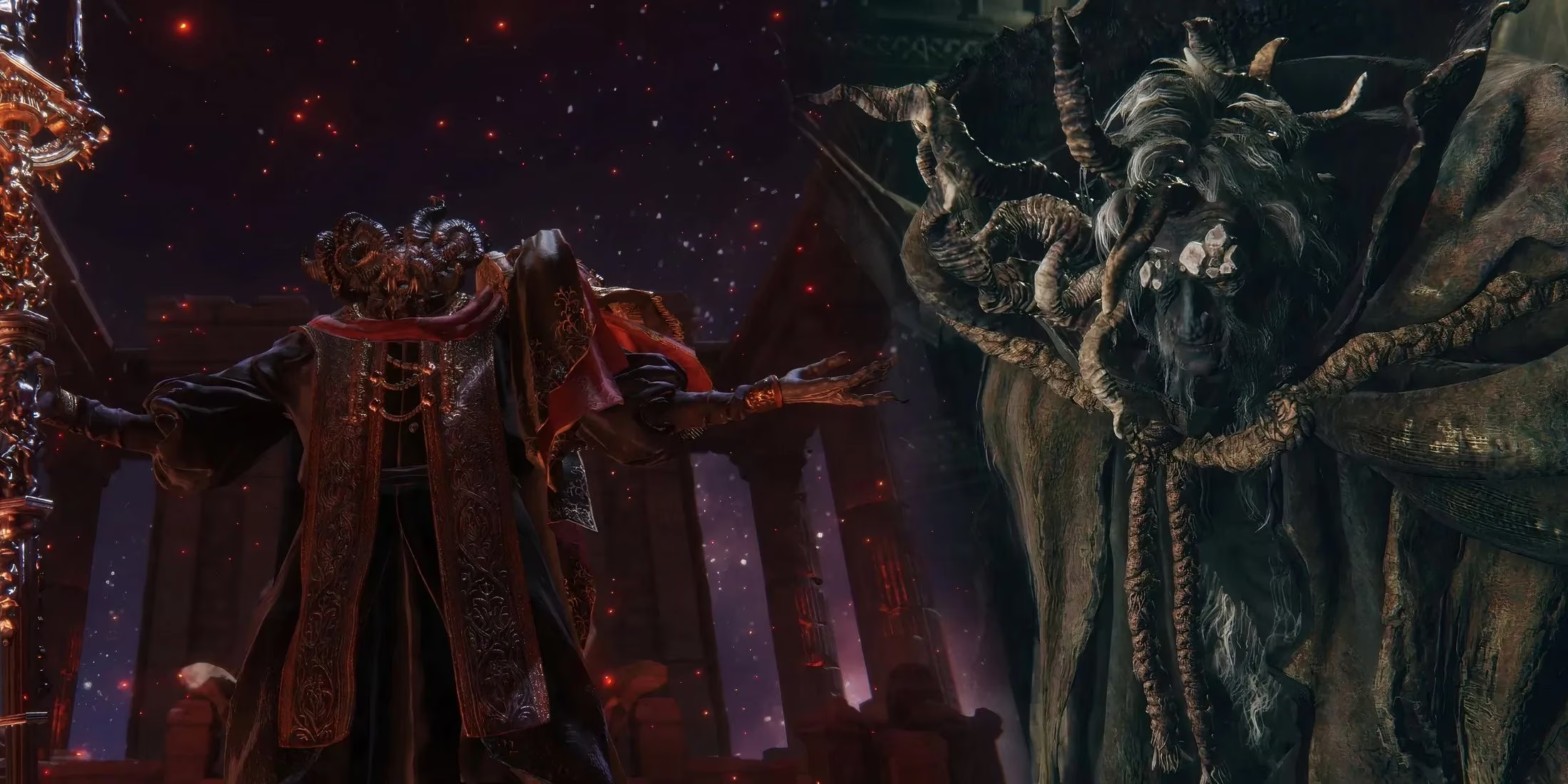
Rennala's power was once unquestioned. As Queen of the Full Moon and head of the Carian Royal Family, she was a sovereign of immense magical might. Then Radagon, her husband, left her. He abandoned her without explanation to become Queen Marika's consort. This personal betrayal broke Rennala completely.
She retreated into a fantasy, clutching the Amber Egg Radagon left behind—a symbol of her loss—and losing herself in an endless, futile cycle of "rebirthing" phantoms. When we first fight her, she is a husk. She barely fights back in her first phase, a literal shadow of her former self. The true Rennala, the powerful sorceress, only appears as an illusion conjured by her daughter Ranni to protect her broken mother. Rennala's tragedy is a stark reminder: even the mightiest can be brought low not by blade, but by a broken heart. Her kingdom lies in ruins, not from war, but from her neglect born of grief.
The Grotesque Pretender: Godrick the Grafted
Godrick's tragedy is one of pathetic desperation. A descendant of the mighty Godfrey, he was the runt of the Golden Lineage—weak, insecure, and utterly scorned by his kin. His desperate need for validation and power led him down a horrific path: the grafting of corpses and limbs onto his own body.
-
Motivation: To appear strong and claim a throne he was fundamentally unworthy of.
-
Method: The grotesque, sinful art of Grafting.
-
Result: A monstrous, pitiable figure who is more corpse than king.
His death brings no glory, only further humiliation. We find Gatekeeper Gostoc, a lowly servant, stomping on Godrick's corpse, spitting on his memory. Godrick's legacy is shame. He represents the darkest outcome of rejection: a soul so consumed by the need for external validation that it mutilates its own humanity to get it.
The Cursed Twins: Morgott and Mohg - Two Sides of Rejection
Born with the reviled Omen curse, twins Morgott and Mohg were shunned from birth, imprisoned in the depths beneath the capital. Their tragedy is defined by their diametrically opposed responses to the same cruel fate.
| Character | Response to Rejection | Tragic Flaw |
|---|---|---|
| Morgott, the Grace-Given King | Unwavering, desperate loyalty to the Golden Order that spurns him. He defends the Erdtree with his life, denying his own nature to seek a belonging he will never be granted. | His devotion is to a system that considers him an abomination. He fights for a grace that will never accept him. |
| Mohg, Lord of Blood | Defiant rebellion. He embraces his curse and seeks to create his own "Dynasty of Blood," using the power of the Outer God Formless Mother to usurp the Order that exiled him. | His path to power is one of monstrous sacrilege and cruelty, corrupting the demigod Miquella. His rebellion makes him a tyrant. |
One seeks acceptance through service, the other through conquest. Both are doomed, tragic responses to a world that told them they were monsters from their first breath.
The Erased Son: Messmer the Impaler
Introduced in the Shadow of the Erdtree expansion, Messmer's tragedy is one of erasure and bitter loyalty. A son of Marika, he was born with an abyssal serpent coiled within him—a living curse. To contain this threat, Marika sealed him with grace... and then erased him from history.
She hid him away in the Land of Shadow, using him as a commander in a forgotten war. He followed his mother's commands without question, waging war in her name. Yet, for all his service, he remained a secret, unacknowledged by the family and world he was ostensibly protecting. In his final moments, as we defeat him, his thoughts are of Marika. But they are not of love or understanding; they are a curse. His tragedy is that of a tool used and discarded, whose unwavering loyalty was met with eternal obscurity.
The Unfulfilled Pilgrimage: Millicent
Millicent's story is a quiet, personal tragedy that hits with immense force. Afflicted with the Scarlet Rot in the blighted wastes of Caelid, she is determined to journey to the Haligtree. Her goal? To meet Malenia, the Scarlet Rot goddess, whom she believes to be her mother, and to understand her own purpose.
Her quest is a testament to human resilience. She fights her deteriorating condition every step of the way. We can help her by retrieving the Unalloyed Gold Needle, which slows the rot's progression. We see her regain her strength and dignity. There is hope. And that is what makes the conclusion so devastating.
🩹 Millicent's Journey: Determination → Hope → Crushing Incompletion
She makes it to the very roots of the Haligtree, to the very threshold of her goal. And there, just steps away from where Malenia slumbers, the Scarlet Rot finally claims her. Her pilgrimage ends not in reunion or understanding, but in silent death, alone. Millicent's tragedy is a reminder of life's cruel indifference. It doesn't matter how strong your will is; sometimes, fate simply says "no."
In 2026, reflecting on these stories, I'm struck by their collective power. Elden Ring isn't about saving a world; it's about navigating a broken one and witnessing the cost of that breakage on every soul within it. From Blaidd's programmed betrayal to Millicent's unfinished journey, these tragedies weave a tapestry that is far more compelling than any simple tale of good versus evil. They force us to ask: In a world governed by uncaring gods and rigid Orders, what does it mean to be human? The answer, it seems, is to struggle, to love, to defy, and, most often, to fail—but to do so with a dignity that the world itself has forgotten.
Leave a Comment