In the year 2026, the boundaries between FromSoftware's celebrated worlds continue to blur in the most unexpected ways. A recent modding breakthrough has once again demonstrated the uncanny similarities in the foundational DNA of titles like Armored Core 6: Fires of Rubicon and Elden Ring. While one immerses players in epic clashes between colossal mechanized warriors, and the other in mythic struggles against dragons and demigods, a dedicated modder has proven they are, quite literally, built from the same digital clay. This revelation isn't just a technical curiosity—it's a testament to the studio's consistent, meticulous design philosophy that allows for such surreal crossovers to exist.
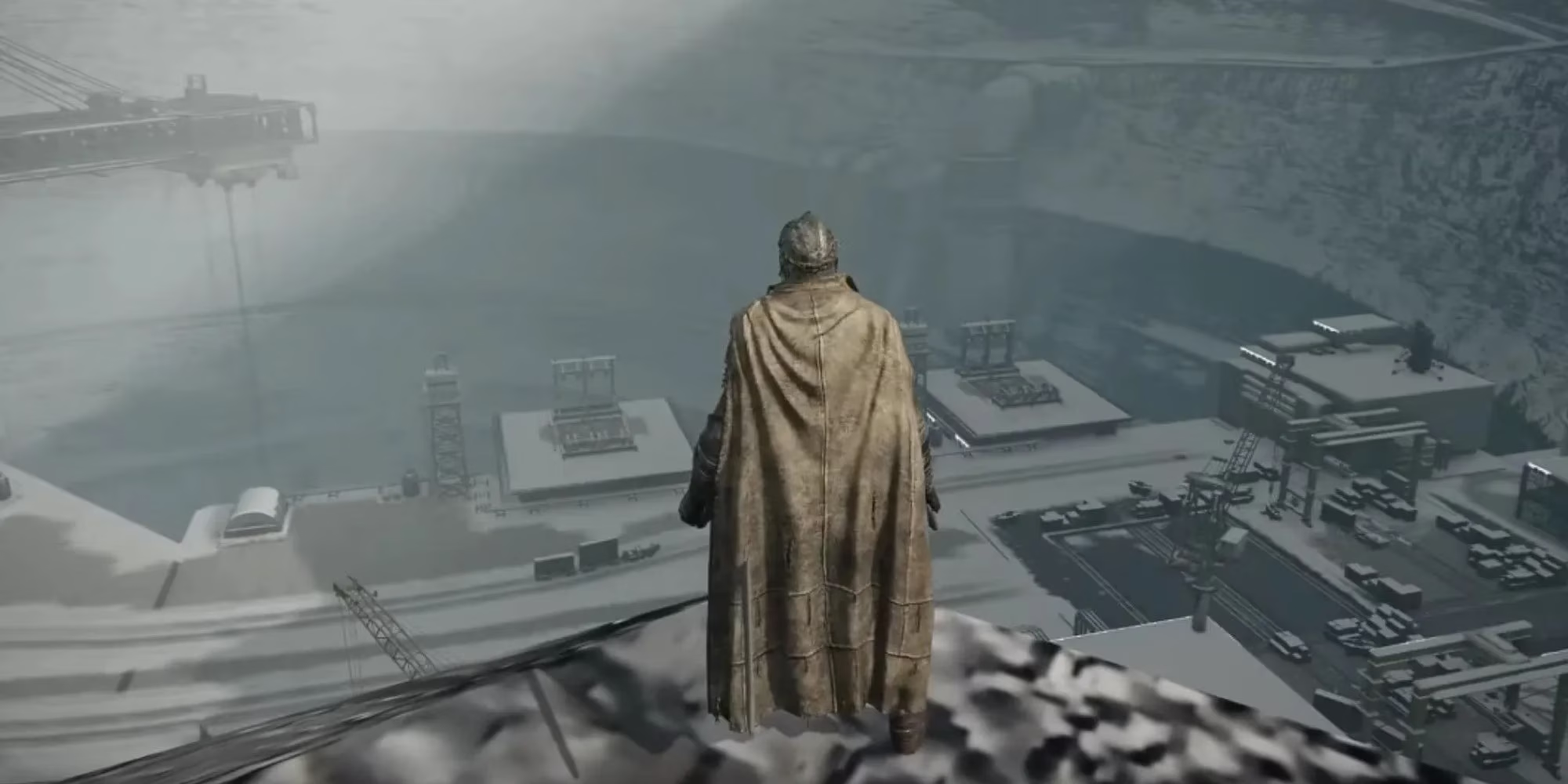
The Modder's Masterstroke: A Portal Between Worlds
The architect of this interdimensional tourism is a modder known as Dropoff. Their project was as ambitious as it was bizarre: transplanting entire maps from the mechanized warfare of Armored Core 6 directly into the fantasy realm of Elden Ring. This wasn't a simple texture swap or a scaled-down diorama. Dropoff successfully imported the full geometry and environmental assets, allowing the Tarnished—Elden Ring's player character—to literally walk the same ground once reserved for 10-meter-tall Armored Cores. Talk about a 'glitch in the Matrix' moment for gaming!
To make traversal feasible (after all, a Tarnished on foot lacks the rocket boosters of an AC), Dropoff granted the character increased speed and a floating ability. This practical tweak had a beautiful side effect: it offered an unprecedented, leisurely view of environments usually seen only in the blur of high-speed combat. The modder showcased three distinct locations:
-
The Vast Canyon: A sprawling desert landscape that suddenly makes the Tarnished feel incredibly small.
-
The Floating City of Xylem: Its towering, intricate architecture takes on a new, awe-inspiring perspective from the ground.
-
The Infamous Tutorial Area: The very map that 'filtered' countless new Ravens at Armored Core 6's launch, now a silent, haunting proving ground for a different kind of warrior.
A Revelation in Scale and Detail
One of the most mind-blowing aspects of this crossover is the confirmation of scale. In Armored Core 6, pilots often 'lose the plot' on how massive their machines are until they glance at a crushed car that looks like a toy. Dropoff's mod proves, without a shadow of a doubt, that FromSoftware designed these environments with perfect, consistent scaling. The buildings are building-sized, the streets are street-wide—it was all real, just waiting for a smaller visitor.
Even more impressive was the discovery of an insane level of detail in objects most players instantly obliterate. When examining the map up close, Dropoff found:
| Asset Category | Observed Detail | Notes |
|---|---|---|
| Destroyed Vehicles | Intact modeling, textured interiors | Visible engine blocks, cabin details |
| Environmental Props | Functional railing, signage | Rare texture glitches (e.g., hexagonal wheels) |
| Architectural Features | Full geometry on distant buildings | No 'cardboard cutout' illusions |
The attention to detail was immaculate, proving FromSoftware 'goes the extra mile' even for set-dressing meant to be blown to smithereens. It’s this consistent craftsmanship that forms the shared backbone of their games.
The Shared FromSoftware DNA
This isn't the first wild crossover between the studio's titles. The modding community has long enjoyed pitting champions from different worlds against each other, like the legendary duel between Sekiro's Wolf and Elden Ring's Malenia. But Dropoff's map transplant highlights something deeper: a unified approach to world-building, physics, and asset creation. It suggests that in the engine's core, a Tarnished, a Raven, and a Shinobi are not so different—they are all entities navigating meticulously crafted spaces governed by similar rules.
The Future of Cross-World Mods
While Dropoff's video primarily showcased empty, peaceful vistas, it cracked open the door to immense possibilities. The modding community is already buzzing with ideas. Imagine the future these tools could create:
-
🤖 An Armored Core, callsign "626," patrolling the skies above Limgrave, its scanner locking onto a Runebear.
-
⚔️ A four-AC squad engaging in a frantic battle with Radahn in the Caelid wasteland.
-
🏰 A Tarnished summon attempting to parry the rapid-fire missiles of an HC Helicopter in the Strider-infested ruins.
As one modder put it, 'the sky's the limit.' While a lightweight Tarnished might get utterly stomped in a direct fight with a NEXT-gen AC (that matchup is 'no contest'), the potential for creative PvE scenarios, racing mods, or pure exploratory tourism is huge.
Conclusion: More Than Just a Technical Feat
Dropoff's project is far more than a neat trick. It's a love letter to FromSoftware's design consistency and a fascinating piece of game archaeology. It shows that whether you're piloting 50 tons of ceramic alloy or wielding a sacred blade, you're experiencing worlds built with the same relentless attention to detail. As modding tools grow more sophisticated, the walls between Rubicon, the Lands Between, and Yharnam will only grow thinner. Who knows? By 2027, we might see a full-blown convergence event. Until then, we can marvel at the sight of a lone Tarnished, standing silently in a canyon made for giants, proving that all of FromSoftware's worlds are, in some way, already connected.
Data referenced from SteamDB helps contextualize why ambitious FromSoftware crossovers like importing Armored Core 6 maps into Elden Ring capture so much attention: with large, active PC audiences and long-tail player activity, technically impressive mods can spread quickly and stay relevant well after launch, encouraging deeper experimentation with shared assets, scale, and traversal tweaks for exploration-focused builds.
Leave a Comment