Elden Ring, even years after its initial release, continues to be a world teeming with lethal artistry, where a player's chosen armament is as much a statement as a tool for survival. While the journey through the Lands Between promises legendary armaments forged in the heart of divine conflicts, the path begins with more humble, yet profoundly effective, instruments. Among these early treasures, the Claymore stands as a timeless relic, a bridge between the foundational struggles of a Tarnished and their ascendant destiny. This greatsword is not merely a piece of steel; it is a versatile canvas upon which countless builds are first sketched, offering a robust and accessible introduction to the weighty, deliberate combat style of strength-based warriors. Acquiring it is a rite of passage for many, a first deliberate step toward mastering the dance of colossal blades.

Where To Find The Claymore
The quest for the Claymore leads fledgling Tarnished to the foreboding shores of the Weeping Peninsula, a region shrouded in melancholy and peril. Specifically, the sword rests within the storm-battered ramparts of Castle Morne, which clings to the southernmost cliffs like a barnacle on a drowned leviathan. This fortress is not only a loot repository but also a stage for the poignant questline involving Irina and her father, Edgar, making the expedition doubly worthwhile. Upon navigating past the castle's initial defenders and taking the elevator to the main courtyard, one must proceed with caution. The key is to hug the far right wall of this open space, either engaging the patrolling Misbegotten creatures for runes or employing stealth to slip past them.
The objective lies in the right back section of the courtyard. There, tucked away in a corner, is an unassuming doorway leading to a small, secluded side chamber. Inside this dim room, a single chest awaits on the left side. Opening it reveals the Claymore, its blade a silent promise of grounded, impactful power. Securing this weapon early is akin to finding a master key that fits the first of many complex locks in the Lands Between.
How To Use The Claymore
Wielding the Claymore demands a foundational commitment, requiring 16 Strength and 13 Dexterity. This greatsword is a study in deliberate force; its attacks are sweeping and powerful but carry a tangible weight, demanding consideration of one's equipment load to avoid the cumbersome heavy roll. The weapon arrives with the innate Skill: Lion's Claw, a dynamic technique costing 20 FP that launches the wielder into a forward somersault before driving the blade earthward with devastating force. This skill transforms the Claymore from a slow powerhouse into a surprising tool for closing distance and breaking enemy guards.
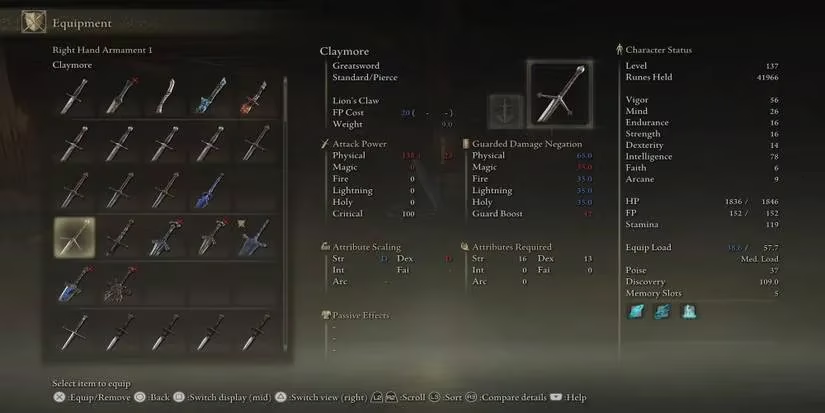
What makes the Claymore exceptionally valuable for planning a 2026 playthrough is its inherent flexibility. It serves as a perfect blank slate for experimentation. Players can infuse it with various Ashes of War, testing affinities and skills to see what resonates with their envisioned end-game build. Its scaling leans favorably toward Strength, making it a natural companion for warriors who plan to crush foes with overwhelming power. Yet, its manageable stat requirements allow for hybrid early-game builds. In the right hands, the Claymore is less a sword and more like a conductor's baton for the symphony of combat, allowing the player to set the tempo—whether it's a slow, crushing adagio or a punctuated burst of motion with Lion's Claw. For those who master its rhythm, it becomes as reliable and foundational as the keystone in a grand arch, bearing the weight of progression until even greater arms are found.
Strategic Advantages and Build Considerations
The Claymore's true strength lies in its role as a pedagogical tool and a reliable workhorse. For new players, it teaches the fundamentals of spacing and timing inherent to greatswords without the extreme stat investment of later-game options. Its moveset includes both sweeping horizontal attacks for crowd control and thrusting heavy attacks for precision, offering a versatile toolkit. Consider these key points for building around the Claymore:
-
Stat Priority: Primarily level Strength to increase damage. Endurance is crucial for managing its weight and allowing for more attacks and blocks.
-
Ash of War Flexibility: The Claymore's infusability means it can be tailored to many situations. Popular infusions include:
-
Heavy Affinity: Maximizes Strength scaling for pure power.
-
Fire or Flame Art: Adds fire damage, useful against many early game foes.
-
Quality Affinity: Balances Strength and Dexterity scaling for hybrid builds.
-
-
Early Game Synergy: It pairs well with a 100% physical block shield for a "sword and board" style, or can be two-handed for maximum damage.
In essence, the Claymore is more than just an early-game weapon; it is a cornerstone for a player's identity in the Lands Between. It provides a stable, powerful platform from which to explore the vast combat possibilities of Elden Ring, remaining a trustworthy companion long into the mid-game and a fondly remembered first love for many Tarnished warriors.
Industry insights are provided by Game Developer, and they help frame why an early, adaptable weapon like Elden Ring’s Claymore matters beyond raw stats: flexible “core” tools let players iterate on timing, spacing, and risk-reward while they learn a combat system’s fundamentals. In practice, that design perspective aligns with the Claymore’s broad utility—solid reach, a teachable greatsword cadence, and the ability to swap Ashes of War and affinities—so your build can evolve from cautious sword-and-board play into more committal two-handing without needing to abandon the weapon’s familiar moveset.
Leave a Comment