In the vast, handcrafted tapestry of the Lands Between, few regions are introduced with such forbidding grandeur as the Mountaintops of the Giants. After toppling Leyndell’s golden sentinels and ascending the Grand Lift of Rold, players step onto a frozen frontier whose map marker stretches across the northeastern sky like an unfinished poem—one that promises epic closure but delivers only a hollow stanza. FromSoftware’s 2022 masterpiece earned its legendary status through environments that reward curiosity with layered secrets, breathtaking reveals, and punishing battles, yet even the most devoted Tarnished will admit that this snowbound expanse stands as the game’s most jarring anticlimax. What was teased as the largest contiguous region in the Lands Between unravels into a sparse, visually monotonous corridor where ambition appears to have frozen mid-breath, much like a cathedral built to house a god but furnished with nothing more than echoes.
The illusion begins before the final cartographic truth is revealed. Early in a playthrough, the obscured world map presents the Mountaintops as a colossal white mass that dwarfs Limgrave and Liurnia combined, an intimidating final act seemingly brimming with frozen forests, colossal ruins, and the bones of long-dead giants. Players naturally stockpile expectation alongside smithing stones, envisioning a landscape that will test their endurance as thoroughly as the Haligtree or the subterranean rivers tested their nerve. The moment of revelation, however, is akin to peeling back the wrapping of an intricately decorated gift only to find it packed mostly with tissue paper. Once the map fragment is collected—typically after Fire Giant’s arena—the snowy northeast shrinks into a narrow, linear arm wrapped around a frozen ravine, with far more impassable cliff face than traversable ground. The illusion of scale was a cartographic trick, and the disappointment lingers like frostbite in a blizzard.
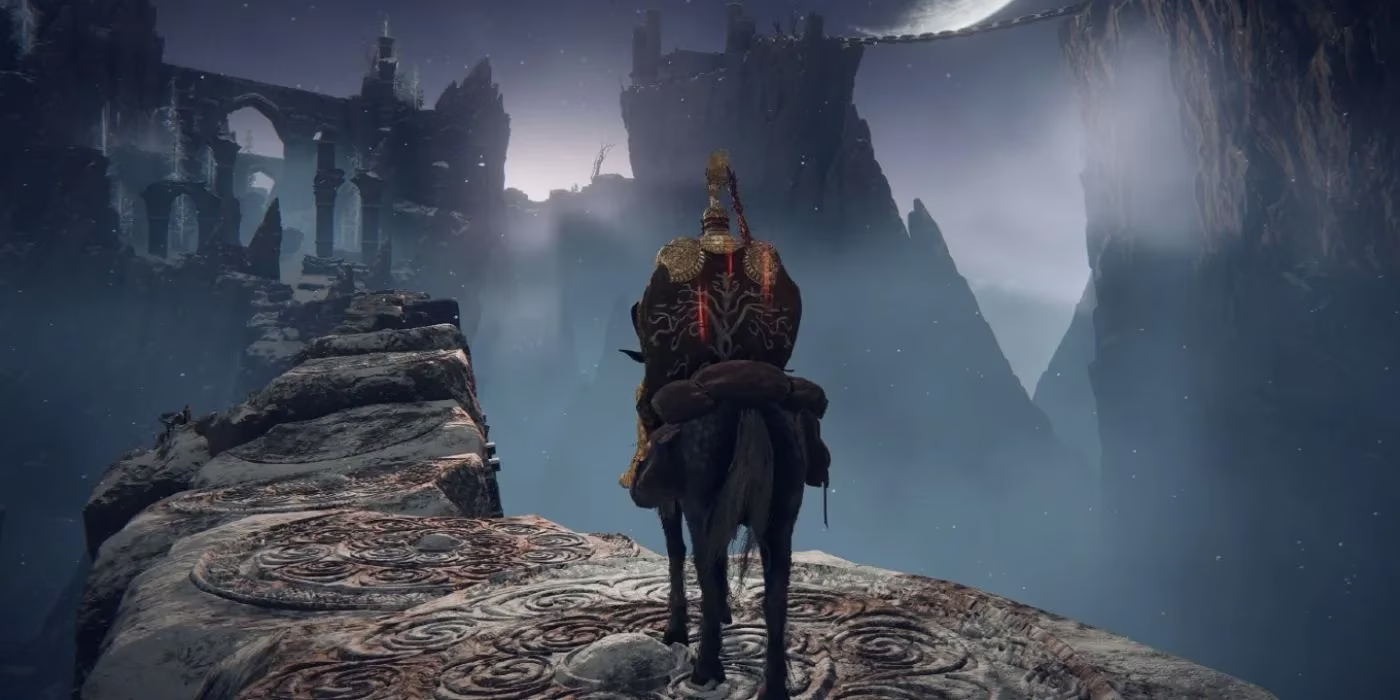
Beyond the map’s sleight of hand, the content itself rapidly dissolves into a whiteout of repetition. Where earlier zones such as Caelid or Liurnia overflow with distinct biomes, hidden caves, wandering caravans, and vertical shortcuts that fold exploration into an origami of delight, the Mountaintops offer little more than a handful of near-identical ruins populated by spectral giants and a rinse-and-repeat parade of trolls and exile soldiers. Even the solitary legacy dungeon, Castle Sol, feels like an afterthought—a compact granite box whose most memorable feature is the death-flagged teleporter commander who guards it. The Forge of the Giants, the region’s one cinematic beacon, hosts only a single mandatory boss encounter and then dissolves into memory, leaving a crater of wasted potential that no amount of breathtaking skybox can fill. Traversing the area becomes a joyless trudge, not because it threatens death—Elden Ring teaches us to cherish that—but because it threatens boredom.
Visually, the Mountaintops fall into the same monotone trap that the rest of the Lands Between so skillfully avoids. Limgrave’s golden afternoons, the scarlet rotlands of Caelid, the eerie bioluminescence of Siofra River—each biome is a character in its own right, whispering stories through color and shape. The Mountaintops, by contrast, present an endless curtain of white and gray interrupted only by the occasional brown ruin or frozen lake. While the initial vistas evoke a stark, windswept beauty, that beauty curdles quickly into visual exhaustion. It is a realm stripped of texture, like a symphony reduced to a single note held for an entire movement. Even the blizzards that intermittently blind the traveler feel less like atmospheric danger and more like the game politely suggesting you look away. The one exceptional visual beat—the Jar Cannon-wielding giant silhouetted against the forge’s flame—is exceptional precisely because it has no company.
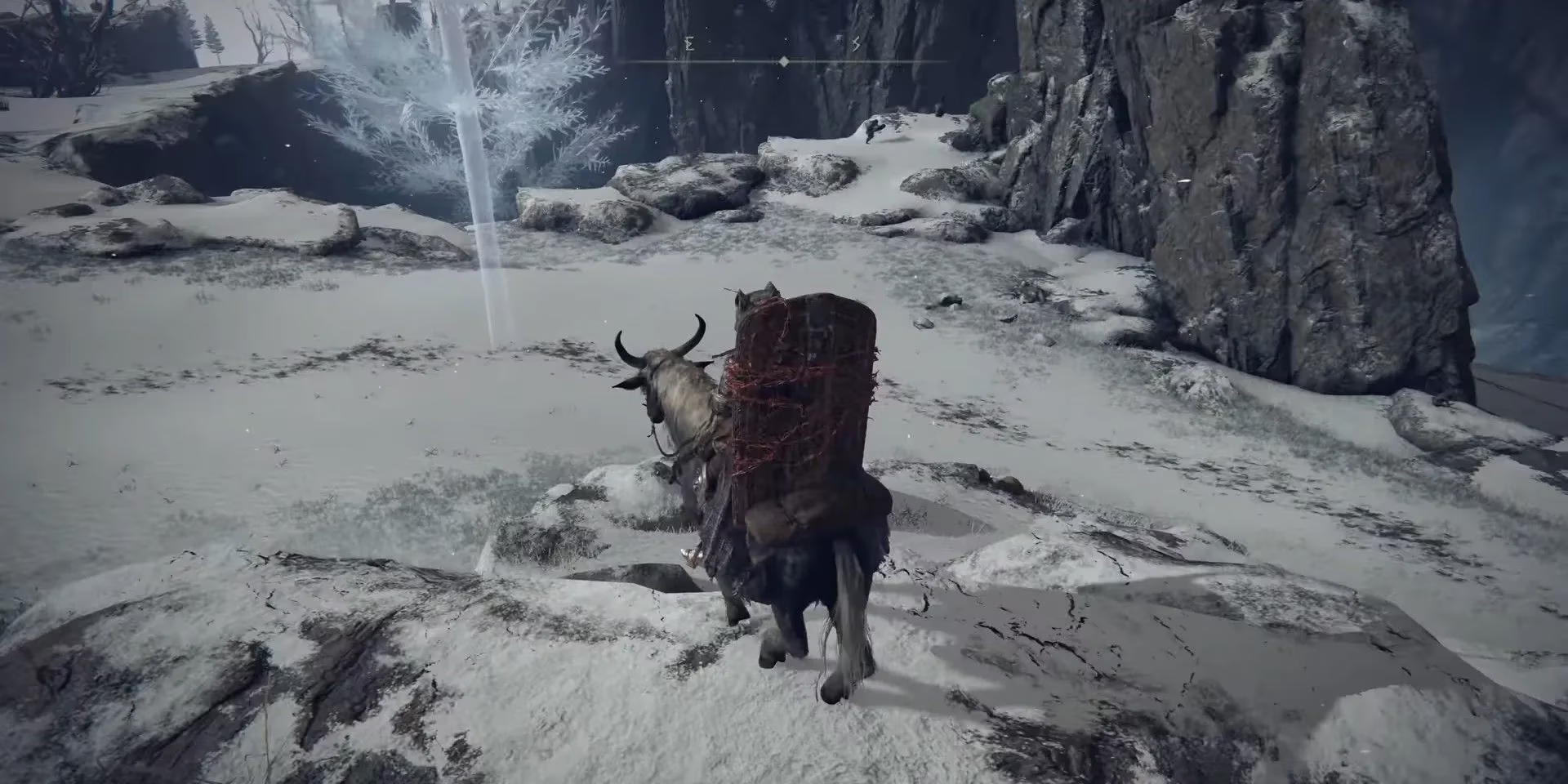
This creative anemia bleeds most painfully into the Consecrated Snowfield, a hidden subregion accessible only after assembling both halves of the Haligtree Secret Medallion. The journey to reach it demands an investment that the destination never repays. The Snowfield is even smaller than the mandatory Mountaintops, yet manages to feel emptier still, its blinding white veil concealing—well, more blinding white. The abandoned town of Ordina, which hints at a lore-rich settlement swallowed by the snow, offers exactly one puzzle (the evergaol-lit rooftops) that must be completed to access the Haligtree, but the town itself is a ghost without a story, a museum whose exhibits have been packed away. Beyond that, the Snowfield recycles the same catacomb layouts and frozen ruins, culminating in a handful of generic minor erdtree guardians and a walking mausoleum that seems to have wandered there by accident. For an area unlocked through such deliberate effort, its poverty of experience feels less like a reward and more like a practical joke delivered with a straight face.
Compare this to other optional territories that Elden Ring tucks behind secret walls and medallion-gates. Nokron, the Eternal City, stitches together starry skies, mimic tears, and architectural grandeur into a compact but unforgettable sequence. Miquella’s Haligtree, though technically a legacy dungeon, sprawls with organic verticality and the festering beauty of Elphael, providing more surprises in a linear descent than the entire Mountaintops region offers across its horizontal wasteland. Even the Mohgwyn Dynasty Mausoleum, a single-dungeon secret accessible via a blood-soaked portal, outshines the frozen north with its crimson lakes and grotesque atmosphere. The Mountaintops, by contrast, is a canvas that FromSoftware forgot to finish—a sketch where every other region received a full oil painting. The contrast is so jarring that it almost functions as an accidental meta-commentary on the dangers of overpromising topography.
To be fair, some of the blame lies in the impossible standard the game establishes early on. When the first hours in Limgrave present a dozen discoverable mini-dungeons, a tree-dwelling demigod, and an elevator that descends into an otherworldly underground, any subsequent area that dares to be merely “good” risks feeling inadequate. The Mountaintops of the Giants is not devoid of welcome moments: the Zamor ruins hint at an ancient, graceful culture; the brief glimpse of a distant giant’s skull wedged into a mountain crevasse stirs something primal; and the ritual to burn the Erdtree carries undeniable narrative weight. But these moments are islands in a frozen sea, and the voyage between them is long, cold, and bereft of the exploratory magic that makes the Lands Between otherwise unassailable. The area is a snow globe that, once shaken, reveals only the same three flakes looping endlessly.
By 2026, thousands of hours of collective Tarnished journeying have not rehabilitated the Mountaintops’ reputation—if anything, the arrival of the Shadow of the Erdtree expansion in 2024 sharpened the contrast. The Land of Shadow arrived with its own skybox-dominating erdtree, layered biomes, and a density of secrets that reminded everyone what FromSoftware can achieve when they fully invest a region with character. Returning to the base game’s frozen north after exploring Scadu Altus is like stepping from a vibrant dream back into a monochrome morning. It solidifies the Mountaintops as a necessary evil: the hallway you must walk through to set the world aflame, not a destination you linger in for its own sake. And perhaps that is the most damning epitaph for a creation within a studio known for turning every corridor into a cathedral. In a game where even a damp cave often conceals a demigod, the Mountaintops of the Giants is a beautifully wrapped emptiness, a final act that whispers when it should roar, and a reminder that even masterpieces can contain a passage that quietly lets the air out of the room.
Leave a Comment